While chatting with postdoc colleagues during this summer’s seminars and lab barbecues, some observations repeated: Many seemed to be off balance and worn down, or at least they felt that their peers were.
Is this a recent thing with LLMs turning academic publishing and programming into even more of a hellscape? Or with the financing problems of Western research systems?
Or is it a structural paradox inherent in hiring people for one-year projects and expecting them to generate output immediately? Of course, that expectation is wildly incompatible with diligent research, let alone academic publication timelines. (It might work if one does not really change labs/subfields, while at the same time, exactly that is expected of postdocs?!)
And then, for half of the year, people spend a big chunk of their mental energy on applying for positions … or on refreshing their email inbox to hear back from grant and hiring committees.
LinkedIn isn’t all that bad, is it? It’s been one year since I started using it, originally to keep in touch with my Berlin colleagues while going to Paris. (In France, I’ve even been forced to create a WhatsApp account …)
A lot of people seem to hate LinkedIn, and for sure, there exist some ridiculous cultures on this platform. Still, my experience has been quite nice.
It’s not as life-changing as using Twitter in the ’00s, which really transformed how I received news. But quite often, I learn about interesting stuff and discussions that are going on, and that much better than in the dumpster fires that the other big platforms have become. Also, LinkedIn provides a nice place to put occasional thoughts and observations.
And, the nicest surprise: I even met some old friends again thanks to LinkedIn. :D (Including two friends from the golden pre-social-network times of message boards, IRC, and ICQ!)
Exactly 30 years ago, one of the biggest movies on the importance of software quality hit theaters.
“Independence Day” (1996) revamps H.G. Wells’s “The war of the worlds” (1897) about aliens invading earth, for an American 90s audience. It’s a crazy summer blockbuster with lots of special effects—from the time back when special effects were special, love it! At the same time, it captures an era: It transfers Wells’s parable on British colonialism to the post-Cold-War moment where people briefly could think that the one thing to ever threaten American hegemony could only be extraterrestrial powers.
But what I, as a software engineer, love about the movie is its thesis on the one thing that might bring down an extremely advanced alien armada: its own poor software quality. Seems about right! I will not spoil the ending here, you should go watch it!
If you take the aliens‘ perspective for a second, it might well be the most epic tragedy on how necessary it is to get your software right. So let’s not be like the imperialist aliens! (Also in other regards, by the way.)
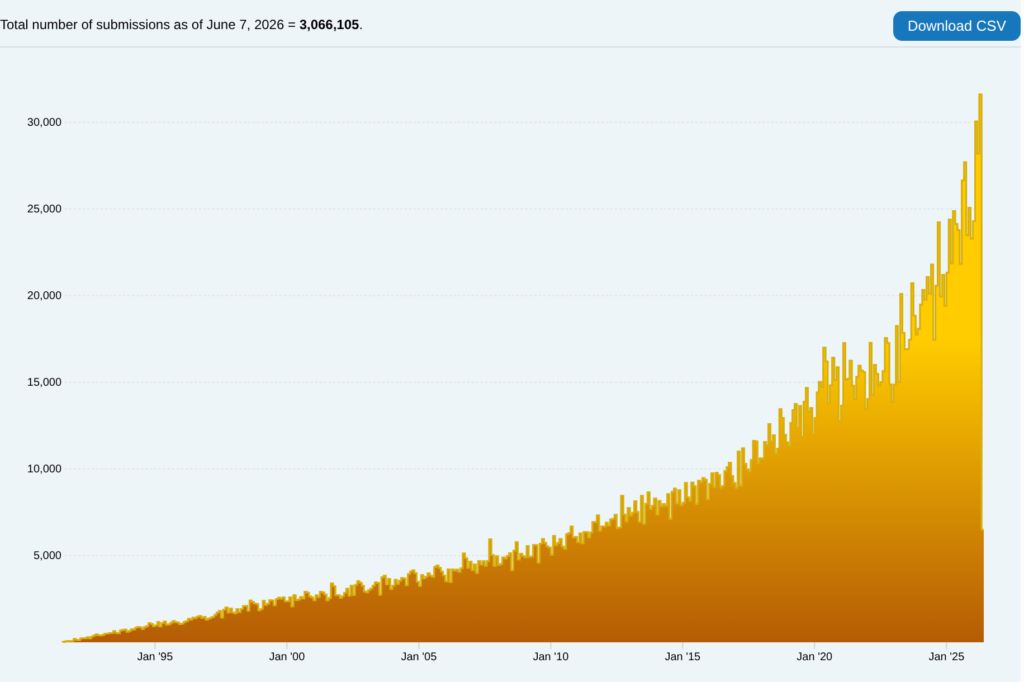
I find it really hard to imagine that, five years from now, scientific papers will still play any role like today. The exponential growth of arXiv submissions is not sustainable. And the trend of students spamming conferences with AI-slop papers has just begun. Let’s think about the previous functions of academic publications and extrapolate!
The publication fetish
Already before the LLM-explosion, looking at papers and publication counts, made people miss the underlying social relationships.
The function of science as a system is to figure out what is true about the world and—on the social side of things—to establish whom to trust on this. For example, when a university awards a degree, this is supposed to signal that someone can be trusted to know their way around a certain field and to discover new facts in it.
A publication, in the classical sense, documents some progress a group of researchers has made in understanding the world. The stated aim of this is to let scientists build upon each other’s work, but in the “publish or perish” age, the role of publications has shifted to their secondary signal:
A publication is understood to say something about the trustworthiness of the authors. They’ve published on this-and-that, hence, they should be experts on this topic, should be able to decide which students to pass or fail, should be established in the community, should handle research funds well, and so on. Because it’s virtually impossible to measure who are the right people to fill such roles, publication and citation counts were considered a good proxy, and fetishized.
This second nature of publications made them serve as a form of capital on CVs and grant applications. The more that publication counts explode though, the more they implode as a currency.
When today’s paper culture developed during the 20th century, there were big physical filters on article production: How many drafts can one author and send around physically, how many papers can be typeset, printed and deployed to libraries? These filters have been removed by the internet age. Accompanied by many advantages, it led to a culture where individual papers are read far less than before. (Including big names that quite certainly do not even read the numerous papers that feature their own names…)
Publications continued to carry meaning about the world and to signal something about the authors. This was possible because many filters remained: Who is affiliated with a research institution, has the training, knows LaTeX, brings pedigree, cares enough to research the specific topic, puts in the time for the writing, and so on? (Not all of these filters are good.) The most important filter has been peer review: If something is formally published, at least some trustworthy people beyond the authors have cared enough about the draft to give it a close reading and have approved it.
LLMs tear down this second system of filters: It’s quite easy to produce something that looks like a reasonable paper, but that’s pure bullshit or only a glorified version of the first page of Google hits on a question. Even if LLMs were solely used constructively, they would inflate the paper production to the point where the currency devalues. However, something worse is to be expected.
The perfect storm for peer review?
I’ve seen many people argue for stronger peer review and more rigorous standards to stop AI slop publications. But this ignores the resource imbalance in this arms race:
Suppose there are twice as many drafts written per researcher but the number of slots at top conferences stays the same, then there will be more rejections and the number of necessary reviews might well quadruple. Reviews can only be sped up by AI so much before they become slop themselves. Slop reviews will not reliably stop slop papers.
If more reviews have to happen per researcher, the signal of conference publications (as information about the quality of the research and the researchers) will continue to degrade. And the more random the signal, the more it pays off to submit even more slop.
In this scenario, that there is a paper on something or that somebody appears as author of a paper would stop to carry meaning. One should expect a resurgence of more elitist practices of how truth and expertise are established, e.g. with CV points about training at top schools (maybe a new kind) or membership in clubs (maybe Signal groups).
The DDoS on peer review might be stoppable by strong rate limits on publications. (E.g. only one or two submissions per author for a top conference; or a group of conferences, rate-limiting submissions per author among them; or pay-per-submission.) Such measures seem unlikely as long as big shots are themselves used to having their names on dozens of submissions and conference rankings care about rejection ratios. But clearly, some re-establishment of filters would be necessary to save the peer reviewing system.
For the non-peer-reviewed part of science (arXiv etc.), different routes would be needed, and, likely, they would continue to point in the direction of making it more elitist again.
These thoughts only concern the question of how to preserve a system that already had been quite broken. And it forgets a deeper supply chain problem …
Or the paper culture just ends
The current publication ecosystem relies on a pipeline where reading and writing papers plays a crucial role in the training of students. But from what I hear from colleagues who teach such courses, I would not expect that there will be a steady supply of people proficient in the dying art of paper reading and writing.
In the extreme case, the question would be: What’s the point of producing A4-formatted PDFs of text that only pretends to be written by humans for humans, but where there aren’t many humans left who care about reading or writing such texts? Should one continue this cultural practice? (As folklore to go with graduate caps?) Will there still be a notion of authorship?
Does the ICORE ranking hate theoretical computer science? There’s been some discussion about traditional A-conferences on formal methods such as ITP, CONCUR, FM, FoSSaCS being downgraded to B in the current ICORE ranking.
Attached graph plots the changes of all theory-of-computation venues that have ever been B or above after 2020: For 2023, a third of B has been sent to C; and now, 2026, half of A to B. On the other hand, there’s almost no upwards mobility of ranks in the field. If you want to look deeper into the ranking changes, I’ve pushed the scraping and visualization script to https://github.com/benkeks/icore-ranks.
Funding and career paths at many universities depend on this ranking. So while it’s questionable whether CORE’s idea of “impact” actually is meaningful, another thing is certain: This year’s slashing of A-venues *will* impact the field.
Unless, of course, we agree to more often ignore the CORE ranking regime …
So viel Wind um eine Packung Eier! (Angeblich von einem Schaubühnen-Mitgründer für 1,99 D-Mark erstanden.) Was sind ein paar Eier gegen einen Krieg, der drei Millionen Leben fordern wird?
Aber die Aufladung hatte natürlich Hintergründe: Die existentielle Abhängigkeit West-Berlins von den USA kollidierte mit der moralischen Verfehltheit des amerikanischen Kriegs in Vietnam. Das akademische Weltverbesserertum einerseits tanzte mit den Ressentiments rechter Milieus gegen Studierende und Unis andererseits.
Gerade die letzten Jahre in Berlin haben uns gezeigt, dass diese Abgründe noch lange nicht überwunden sind. 1968 begann in West-Berlin also zwei Jahre zu früh – und offenbar ist es immer noch nicht ganz vorbei.
Ich habe Rita Süssmuth († 2026-02-01) nie ganz verstanden.
Eigentlich scheint es doch ein Naturgesetz: Genug Zeit in der Politik macht Menschen zu Arschlöchern oder zynisch oder resigniert. Mindestens ein Bisschen. Nicht so bei Rita Süssmuth – nach all ihren Jahren in höchsten Rollen bis hin zur Bundestagspräsidentin! Sie war aus einem anderen Material.
Wann immer ich sie im Kuratorium der TU Berlin aus der Nähe erlebte, und auch bei ihren öffentlichen Auftritten: Nie fehlte es ihr an Herz, Mut und Zuversicht. Umso mehr wird sie fehlen.🕯️
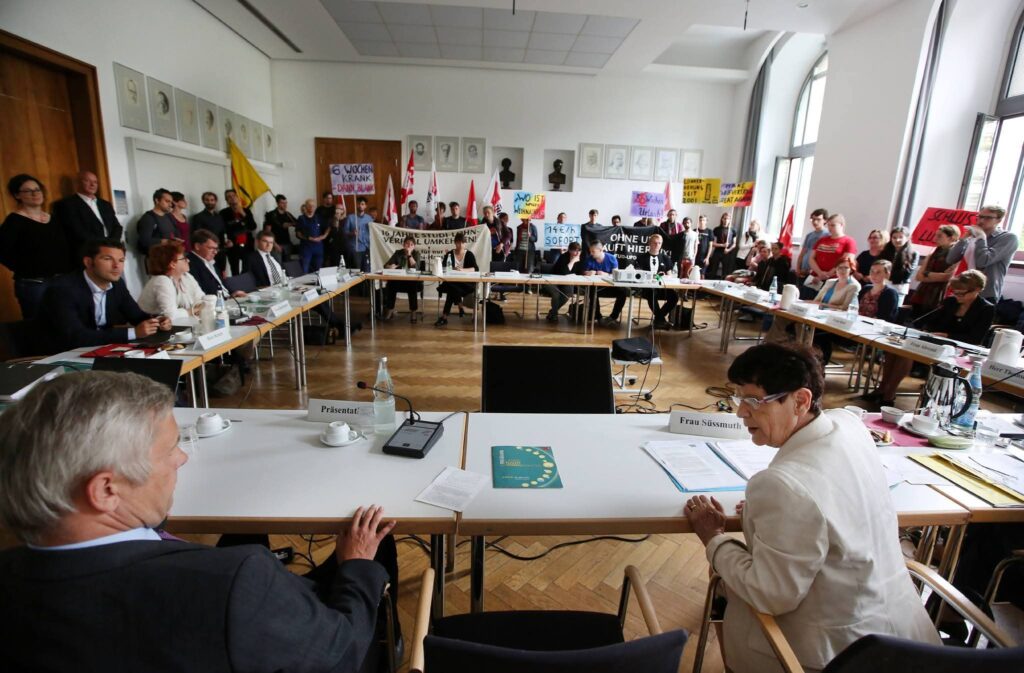
Rita Süssmuth bei der Leitung der TU-Kuratoriumssitzung vom 2017-06-13. Sie ließ sich von unserem kleinen Besuch (angesichts TVStud-Tarifverhandlungen) nicht aus dem Konzept bringen und machte sich beim Präsidenten (links) und anderen Kurator:innen stark dafür, auf „die jungen Leute“ zu hören.
Der Politikstil, der Rita Süssmuth gelang, ist nicht leicht nachzumachen. Ich hoffe, viele versuchen es dennoch!
Today is World Logic Day. So, I want to give some attention to one of the coolest games on temporal logics that students have developed in my TU Berlin courses.
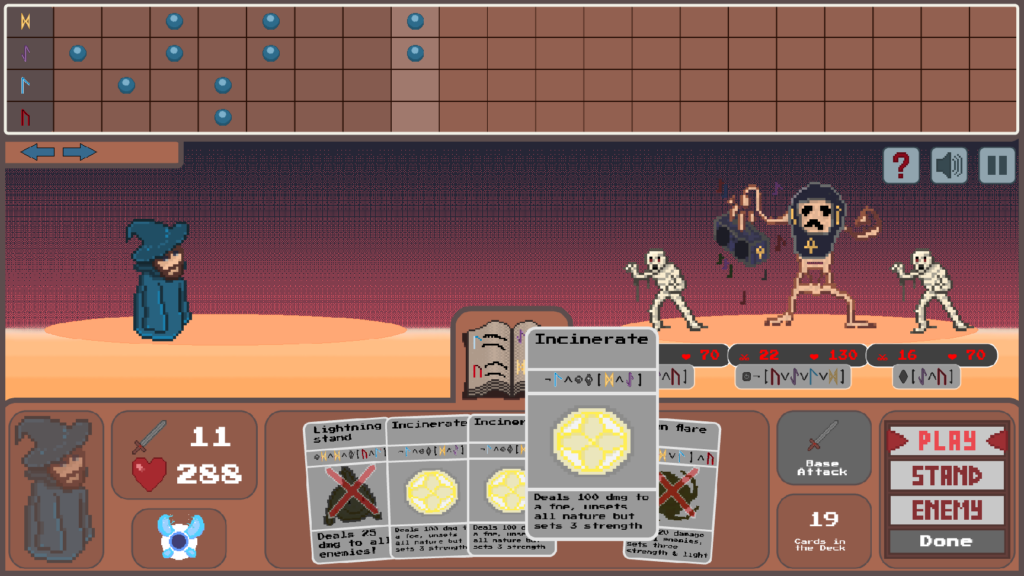
In Tempus Fugit, you play a mage fighting monsters. 🧙♂️🧟 Which spells you can cast (and their strength) depends on past and future events and is expressed in a variant of linear temporal logic (LTL). LTL is one of the most important temporal logics in computer science, where it is used, for example, to describe the behavior of programs.
I’ve been an Isabelle/HOL user for 15 years, finished several projects in it, and taught it to many students and colleagues. But maybe it’s time to jump on the Lean train?
In 2021, I was at a similar crossroads. Should I formalize my PhD research in Lean or Isabelle? Lean was just upgrading from 3 to 4, disregarding structured proofs. While I like functional programming and the Curry–Howard correspondence, I don’t think the way Lean (and Rocq) double down on it helps readability. Finally, I opted for Isabelle because of its maintainable proof syntax and clarity.
Since then, Lean has continued to take off. That’s annoying for experts, as the booming community means that people keep reinventing the wheel and producing a lot of not-so-elegant stuff. Isabelle on the other hand is as walled a garden as an open source project can be. (No GitHub repo, special versioning system and tech stack. Giant barriers against drive-by pull requests and issue reports!)
The cited core maintainer is known for his particular style of communication on the mailing list—so, one should not take the offensiveness of the quoted sentence too seriously. But there’s something else about the attitude it reveals:
It seems that a maintainer writing a sentence like “Better use [our competition] then!” has already given up the fight for his system to be the one that people will use in the next decade. It tastes of seeing the writing on the wall and actively refusing to adapt to new trends, in order to not feel passive about it.
I might be totally wrong about all this. Maybe, it’s the right strategy to keep Isabelle on an island. But still, I can’t unsee the dynamic I think to see. And for me, the possibility to use a system in VS Code as well as maintainer attitude contribute to turning the scale on which system to use for my next 10000 lines of formalized math.
So, what do you think? Should one “better use Lean“? (Or Rocq? ;) Or re-learn pen-and-paper math? ;P )
Diesen Herbst wählen die Gremien der TU Berlin ein neues Präsidium. Amtsinhaberin Geraldine Rauch kandidiert erneut. Aber drei vier weitere Bewerber:innen fordern sie öffentlich heraus.* Das ist eine bei Uniwahlen eher ungewöhnliche Situation, die ich hier fair würdigen möchte. Ich habe 15 Jahre Präsidentschaftswahlen an der Technischen Universität Berlin mitbekommen und jetzt den Luxus, von außen offener darüber nachzudenken. (Update mit neuer Bewerbung am Ende.)