
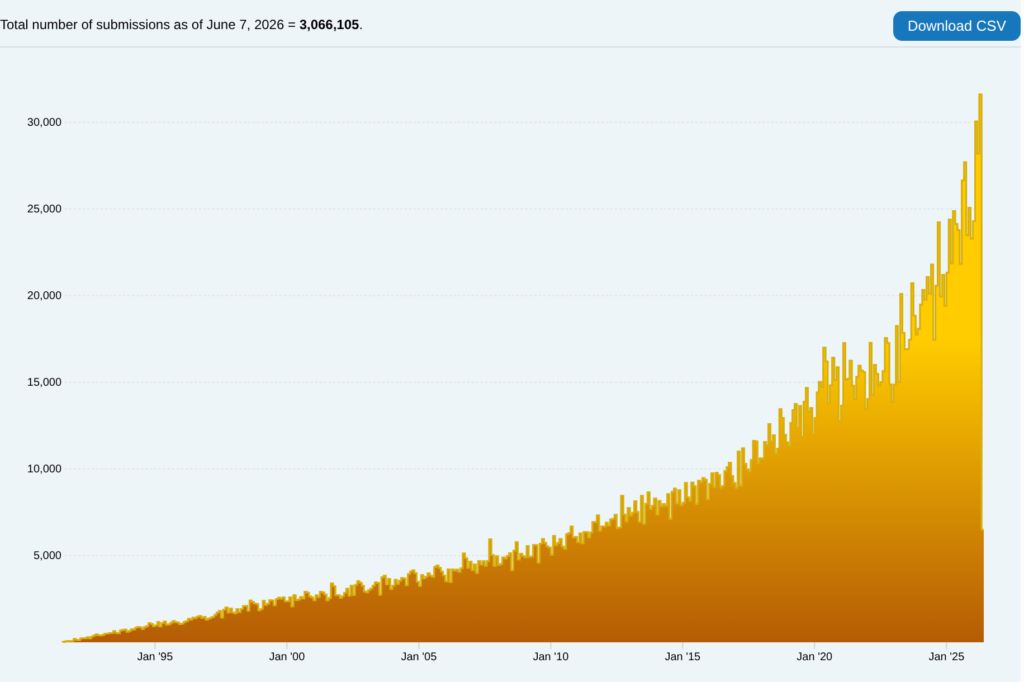
I find it really hard to imagine that, five years from now, scientific papers will still play any role like today. The exponential growth of arXiv submissions is not sustainable. And the trend of students spamming conferences with AI-slop papers has just begun. Let’s think about the previous functions of academic publications and extrapolate!
The publication fetish
Already before the LLM-explosion, looking at papers and publication counts, made people miss the underlying social relationships.
The function of science as a system is to figure out what is true about the world and—on the social side of things—to establish whom to trust on this. For example, when a university awards a degree, this is supposed to signal that someone can be trusted to know their way around a certain field and to discover new facts in it.
A publication, in the classical sense, documents some progress a group of researchers has made in understanding the world. The stated aim of this is to let scientists build upon each other’s work, but in the “publish or perish” age, the role of publications has shifted to their secondary signal:
A publication is understood to say something about the trustworthiness of the authors. They’ve published on this-and-that, hence, they should be experts on this topic, should be able to decide which students to pass or fail, should be established in the community, should handle research funds well, and so on. Because it’s virtually impossible to measure who are the right people to fill such roles, publication and citation counts were considered a good proxy, and fetishized.
This second nature of publications made them serve as a form of capital on CVs and grant applications. The more that publication counts explode though, the more they implode as a currency.
Vanishing filters
When today’s paper culture developed during the 20th century, there were big physical filters on article production: How many drafts can one author and send around physically, how many papers can be typeset, printed and deployed to libraries? These filters have been removed by the internet age. Accompanied by many advantages, it led to a culture where individual papers are read far less than before. (Including big names that quite certainly do not even read the numerous papers that feature their own names…)
Publications continued to carry meaning about the world and to signal something about the authors. This was possible because many filters remained: Who is affiliated with a research institution, has the training, knows LaTeX, brings pedigree, cares enough to research the specific topic, puts in the time for the writing, and so on? (Not all of these filters are good.) The most important filter has been peer review: If something is formally published, at least some trustworthy people beyond the authors have cared enough about the draft to give it a close reading and have approved it.
LLMs tear down this second system of filters: It’s quite easy to produce something that looks like a reasonable paper, but that’s pure bullshit or only a glorified version of the first page of Google hits on a question. Even if LLMs were solely used constructively, they would inflate the paper production to the point where the currency devalues. However, something worse is to be expected.
The perfect storm for peer review?
I’ve seen many people argue for stronger peer review and more rigorous standards to stop AI slop publications. But this ignores the resource imbalance in this arms race:
Suppose there are twice as many drafts written per researcher but the number of slots at top conferences stays the same, then there will be more rejections and the number of necessary reviews might well quadruple. Reviews can only be sped up by AI so much before they become slop themselves. Slop reviews will not reliably stop slop papers.
If more reviews have to happen per researcher, the signal of conference publications (as information about the quality of the research and the researchers) will continue to degrade. And the more random the signal, the more it pays off to submit even more slop.
In this scenario, that there is a paper on something or that somebody appears as author of a paper would stop to carry meaning. One should expect a resurgence of more elitist practices of how truth and expertise are established, e.g. with CV points about training at top schools (maybe a new kind) or membership in clubs (maybe Signal groups).
The DDoS on peer review might be stoppable by strong rate limits on publications. (E.g. only one or two submissions per author for a top conference; or a group of conferences, rate-limiting submissions per author among them; or pay-per-submission.) Such measures seem unlikely as long as big shots are themselves used to having their names on dozens of submissions and conference rankings care about rejection ratios. But clearly, some re-establishment of filters would be necessary to save the peer reviewing system.
For the non-peer-reviewed part of science (arXiv etc.), different routes would be needed, and, likely, they would continue to point in the direction of making it more elitist again.
These thoughts only concern the question of how to preserve a system that already had been quite broken. And it forgets a deeper supply chain problem …
Or the paper culture just ends
The current publication ecosystem relies on a pipeline where reading and writing papers plays a crucial role in the training of students. But from what I hear from colleagues who teach such courses, I would not expect that there will be a steady supply of people proficient in the dying art of paper reading and writing.
In the extreme case, the question would be: What’s the point of producing A4-formatted PDFs of text that only pretends to be written by humans for humans, but where there aren’t many humans left who care about reading or writing such texts? Should one continue this cultural practice? (As folklore to go with graduate caps?) Will there still be a notion of authorship?
And what will come after papers?